






Berberine HCL vs Phytosome: Differences? Which is better?
In the field of plant extracts, Berberine has attracted considerable attention from manufacturers due to its wide range of biological activities. However, the two common forms of berberine on the market—berberine hydrochloride(Berberine Hcl) and berberine phosphosome—often present a dilemma for buyers.
As a professional plant extract supplier, Kintainutri® will analyze the differences between the two from the perspectives of ingredient properties, production applications, and cost-effectiveness to help you understand why berberine HCl is more suitable for large-scale production needs.
Composition and Absorption Mechanism
Berberine is a natural isoquinoline alkaloid found in plants such as Coptis chinensis and Phellodendron amurense. However, Pure berberine has poor water solubility and low bioavailability, necessitating the optimization of its formulation. This is the core difference between the two common forms:
Berberine hydrochloride (Berberine HCl): The salt form, obtained through hydrochloric acid treatment, significantly improves water solubility (solubility in water can reach over 50 mg/ml). Its absorption mechanism is passive diffusion, allowing it to cross the intestinal cell membrane without a carrier. Although slightly affected by the intestinal environment, absorption efficiency is more easily controlled in standardized production.
Berberine Phytosome: Berberine is combined with phospholipids to form a complex designed to enhance intestinal absorption through the phospholipids' "carrier" effect. However, this combination requires a specific process, and the phospholipid component may interfere with the formulation stability of the final product, making it particularly unsuitable for moisture-sensitive formulations.
For manufacturers, berberine hydrochloride's water solubility simplifies the production process—no additional solubilizer is required, allowing it to be directly mixed with excipients for dosage forms such as tablets, capsules, and oral solutions, reducing process complexity.
Berberine Hydrochloride Better Meets Industrial Needs
Large-scale production is highly sensitive to raw material stability, compatibility, and cost, which is precisely the core advantage of berberine hydrochloride:
1. Enhanced Stability and Withstands Complex Processes
Berberine hydrochloride exhibits excellent stability at high temperatures (below 60°C) and in neutral to slightly acidic environments, making it suitable for common industrial processes such as tableting, granulation, and sterilization.
However, the phospholipids in phospholipid complexes are susceptible to oxidation, potentially producing a rancid odor during long-term storage or high-temperature processing. This requires the addition of antioxidants, increasing production costs.
2. Broader Compatibility and Adaptability to Multiple Dosage Forms
Whether in health supplement tablets, functional beverages, or animal feed additives, berberine hydrochloride is compatible with common excipients such as starch, cellulose, and minerals, without precipitation or separation.
In contrast, phospholipid complexes, due to their fat-soluble components, are prone to phase separation when mixed with water-soluble excipients, limiting their application in oral liquids and water-soluble granules.
3. Controllable Purity and Clearer Quality Inspection Standards
Kintainutri®'s berberine hydrochloride, as tested by HPLC, has a purity exceeding 98%, and heavy metal content (lead, arsenic, and mercury) is below 0.1 ppm, meeting international standards such as USP and EP.
However, testing the active ingredients of phospholipid complexes requires simultaneous determination of berberine and phospholipid content, a complex method with high error rates, making quality control more challenging.
Berberine hydrochloride is more cost-effective
For manufacturers, raw material costs directly impact product competitiveness. Berberine hydrochloride's cost advantages are reflected throughout the entire supply chain:
Production: Berberine hydrochloride's production process is mature, requiring only plant-based extraction followed by hydrochloric acid crystallization, eliminating the need for complex reaction equipment. Leveraging its plant cultivation base and supercritical CO₂ extraction technology, Kintainutri® maintains unit production costs within 60% of those of phospholipid complexes.
Logistics and Storage: Berberine hydrochloride is a dry powder with flexible storage conditions (room temperature, sealed) and does not require a cold chain for transportation. Its logistics costs are over 30% lower than those of phospholipid complexes, which require low-temperature storage.
Scaled Procurement Discounts: Kintainutri® supports bulk orders ranging from 1 kg to 1 ton, with additional discounts for purchases over 500 kg. Samples are also available to help manufacturers reduce pilot production risks.
Why Do Most Companies Choose Berberine Hydrochloride?
In the fields of functional foods, pharmaceutical intermediates, and feed additives, berberine hydrochloride has far more applications than phospholipid complexes:
Health Products Industry: A well-known dietary supplement brand compared two raw materials for the production of berberine capsules. They found that the hydrochloride form reduced the disintegration time of the finished product by 20%, and after a three-month accelerated test, the active ingredient retention rate reached 95%, while the phospholipid complex group retained only 82%.
Animal Husbandry: Feed additive manufacturers prefer the hydrochloride salt because it can be directly mixed with feed ingredients such as corn and soybean meal, remains active even in silage, and effectively reduces the number of pathogenic bacteria in the animal's intestines.
These cases demonstrate the pragmatic advantage of berberine hydrochloride in industrial production—it doesn't pursue theoretically high absorption rates, but rather meets the needs of large-scale production with stability, compatibility, and low costs.
Kintainutri®: A More Reliable Option for Manufacturers
As a supplier with 15 years of experience in the plant extract field, Kintainutri®'s berberine hydrochloride fully meets manufacturers' needs in terms of raw materials, processes, and services:
Raw Material Guarantee: Selected raw materials are sourced from the Sichuan Coptis chinensis GAP cultivation base to ensure an initial berberine content of ≥9.0%, controlling extraction efficiency from the source.
Process Advantages: Utilizing "low-temperature dynamic extraction + membrane separation and purification" technology, the product's particle size can be customized (80-200 mesh) to meet the mixing requirements of different dosage forms, thereby avoiding high-temperature damage to active ingredients.
Complete Qualifications: ISO9001 and ISO22000 certified, each batch of products comes with a COA, MSDS, and other documentation, supporting customs inspection and customer re-inspection.
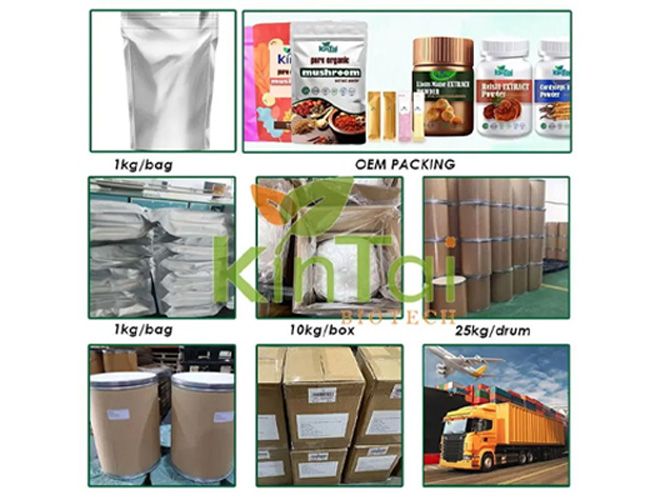
Flexible Service: We offer packaging options such as 1kg aluminum foil bags and 25kg cardboard drums, and support custom label printing. Orders are shipped within 48 hours of order placement, ensuring uninterrupted production schedules.
Conclusion
Choosing berberine hydrochloride means choosing production certainty. Although berberine phospholipid complex offers advantages in theoretical absorption rate, its complex manufacturing process, limited compatibility, and high cost make it more suitable for niche, high-end markets. For manufacturers seeking large-scale, standardized production, berberine hydrochloride's water solubility, stability, and cost-effectiveness make it a more practical choice.
Kintainutri® is committed to making plant extracts easier to use in production. Our berberine hydrochloride is more than just a raw material; it's a production solution that helps you reduce costs and improve efficiency. Contact us today for samples and customized procurement solutions, and let high-quality raw materials empower your products.